Trust assessment · Verifiable checks only
Is Audifort Legit? Checking What Can Be Verified
Legitimacy and effectiveness are different questions, and conflating them is how most pages on this topic go wrong. This one asks only the first: is there a real product, a real seller and a real refund route behind the name?
- Real product: yes
- Refund route: documented
- Full formula: not disclosed
Is Audifort legit?
On the checks that can be verified, yes — it is a real, identifiable product with a real seller, published pricing, an established payment processor and a documented refund route. That makes it a genuine commercial offer rather than a fraud. It does not make it effective, which is a separate question the evidence does not currently answer.
What "legit" actually asks
People searching this phrase are usually asking one of three different things: will I receive anything for my money, is the seller real and reachable, or does the product do what the page says. The first two are verifiable from outside. The third is not, and no amount of checking the seller will settle it.
Keeping them apart is the whole discipline here. A completely legitimate business can sell a product with no evidence behind it, entirely lawfully. That is, in fact, the normal condition of the supplement industry rather than an exception.
The checks that pass
- The product exists and is consistently described. Labelling matches across the seller's materials: Audifort, 60 ml / 2 fl oz, dietary supplement, liquid drops.
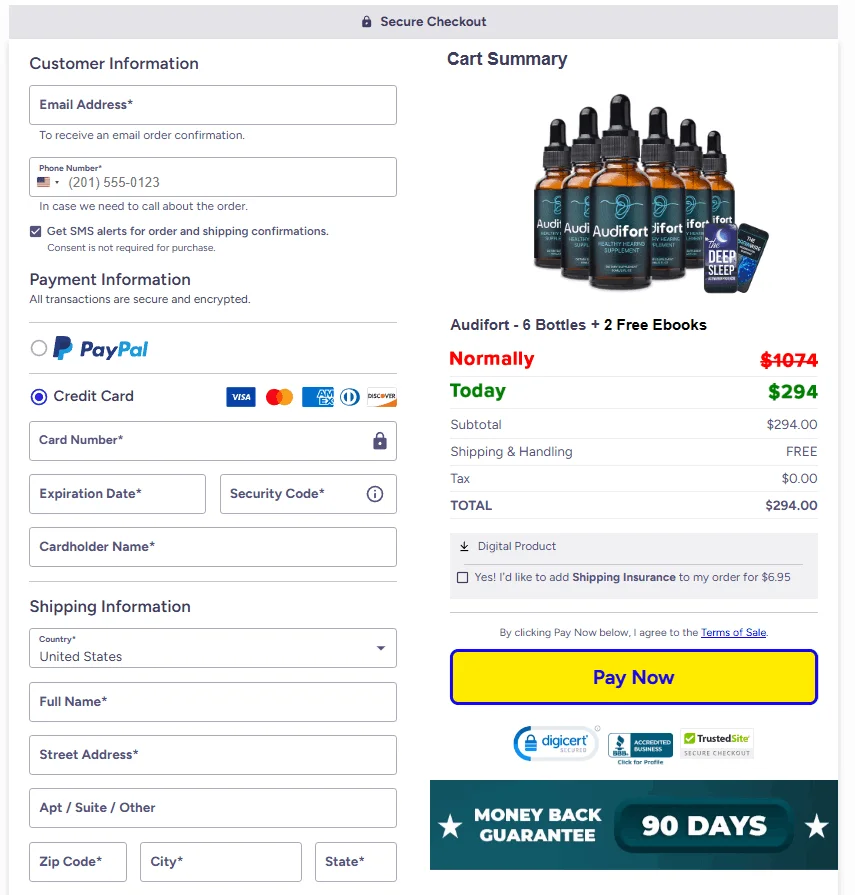
- Pricing is published up front. Three package tiers with per-bottle and total prices stated before checkout, not revealed only at the payment step.
- The offer is internally consistent. Prices, package contents and included bonuses agree between the pricing page and the checkout summary.
- A refund policy is stated. A 90-day money-back guarantee appears consistently across three separate seller materials rather than in one place only.
- Payment runs through an established processor with its own dispute and refund mechanism, which gives a route independent of the seller.
- Ingredients are partially disclosed. Six are named publicly, which is more than several competing products manage.
The checks that do not pass
- No public Supplement Facts panel. Individual amounts are not published, so the formula cannot be assessed against research.
- Most of the formula is unnamed. Six ingredients against a claimed twenty-plus leaves the majority unlisted, which also prevents allergen checking.
- No verifiable certification. Manufacturing or quality certifications could not be independently confirmed.
- No clinical trial of the finished product. Nothing published tests what is actually in the bottle.
- Marketing in this category is frequently indefensible. "FDA approved" badges appear on supplement pages where no supplement can hold that status.
Why partial disclosure is not automatically dishonest
Proprietary blends and partial ingredient lists are standard commercial practice, not evidence of bad faith. A manufacturer that publishes an exact formula invites a competitor to copy it, which is a real business concern in a market with low barriers to entry.
The consequence for a buyer is unchanged, though. Whatever the motive, non-disclosure means you cannot compare the product against research, cannot check for allergens, and cannot see whether an ingredient appears at a meaningful level or a decorative one. A legitimate reason for a gap does not fill the gap.
Signals that would change the assessment
It is worth being specific about what would make us call this illegitimate, because a checklist you can never fail is worthless. Hidden recurring billing disguised as a one-off purchase. A refund policy that is advertised and then refused on invented technicalities. A checkout that adds items you did not select. A seller who becomes unreachable after payment. Claims to treat or cure a diagnosed condition, which crosses from marketing into a regulatory violation.
We found none of those in the published materials. If you encounter any of them in practice, that is worth documenting and raising with your card issuer.
The verdict, stated carefully
Audifort presents as a legitimate commercial product: identifiable, consistently described, transparently priced and sold with a stated refund route through an established processor. Buying it is not the same as being defrauded.
What it is not is proven. A supplement can be entirely legitimate and still do nothing measurable, and the absence of a finished-product trial means that possibility remains open. Treat the 90-day window as the real protection here, read the refund terms before ordering rather than after, and keep hearing changes in front of a clinician regardless of what you decide about the bottle — sudden or one-sided loss in particular is treated as urgent in clinical guidance.1
Buying safely if you decide to go ahead
Legitimacy checks reduce risk but do not eliminate it, and a few habits close most of the remaining gap. Order through the official checkout rather than a third-party listing, since a resale seller cannot extend the manufacturer's guarantee to you. Pay by credit card rather than bank transfer, because card payments carry chargeback rights that a transfer does not. Read the total at the payment step rather than the per-bottle figure in the headline, and check nothing has been added to the cart that you did not select.
Take a screenshot of the refund terms as they appear on the day you order. Policies change, and a dated screenshot is far more useful in a dispute than a memory of what a page said. Note the refund deadline in a calendar at the point of purchase, not later — the most common way a genuine guarantee fails a buyer is that the window quietly closes while they are still deciding.
What legitimacy does not buy you
It is worth ending on the distinction the whole page rests on. A real company, a real product and a real refund policy tell you that a transaction will be honoured. They tell you nothing about whether a formula affects hearing, because those are established by completely different means — one by commercial record, the other by controlled trial.
The supplement industry is largely populated by legitimate businesses selling products with thin evidence, entirely lawfully. Recognising that is not cynicism; it is the correct frame for reading anything in this category, including this site.
Related Audifort pages
- the scam question examined — what would count as evidence either way
- evaluating complaints — how to judge whether a complaint is meaningful
- supplement scam warning signs — how to inspect any hearing supplement sales page
- purchase information — packages, pricing and the refund window
Frequently asked questions
On verifiable checks it is a legitimate commercial product: consistently described, transparently priced, sold through an established payment processor with a documented refund route. Legitimacy is separate from effectiveness, which the evidence does not currently establish.
Nothing in the published materials suggests otherwise. Orders run through an established payment processor with its own dispute mechanism, which gives you a route independent of the seller if something goes wrong.
A 90-day money-back guarantee is stated consistently across three separate seller materials. The conditions attached to it, including whether bottles must be returned and who pays postage, are set by the seller and should be read on the checkout page before ordering.
No public Supplement Facts panel giving individual amounts was available to us, and only six ingredients are named against a claimed twenty-plus. Partial disclosure is common commercial practice, but it does limit what any reviewer can verify.
Hidden recurring billing, a refund advertised and then refused on invented grounds, a checkout adding unselected items, an unreachable seller, or claims to treat a diagnosed condition. We found none of these in the published materials.
References
Each verified against its PubMed record or issuing body. The complete source list is on the main Audifort guide.
- Chandrasekhar SS, et al. Clinical practice guideline: sudden hearing loss (update). Otolaryngol Head Neck Surg. 2019. PMID 31369359
- Geller AI, et al. Emergency department visits for adverse events related to dietary supplements. N Engl J Med. 2015. PMID 26465986
- Maniaci A, et al. Hearing loss and oxidative stress: a comprehensive review. Antioxidants. 2024. PMID 39061910