Capsicum Annuum
Cayenne / chili pepper fruitThe chili pepper fruit; its capsaicin activates the TRPV1 receptor on sensory nerves. Included for energy and circulation. No hearing outcome has been studied.
Dietary supplement · Liquid drops
Audifort is a liquid dietary supplement marketed for hearing support. What it is, the ingredients its maker actually names, and what the research on them does — and does not — show.
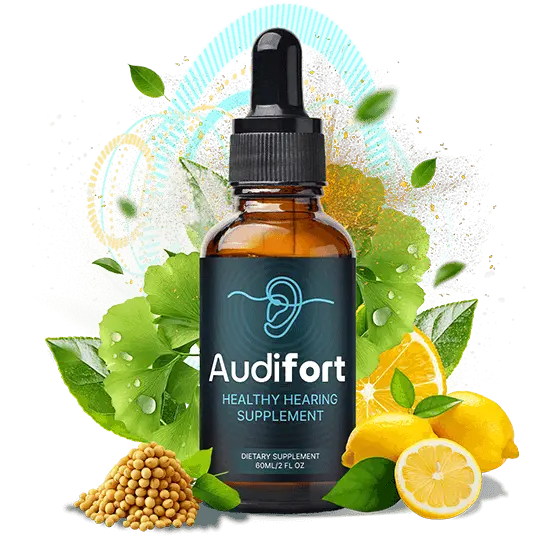
Audifort is a liquid dietary supplement sold in a 60 ml (2 fl oz) amber glass dropper bottle, labelled as a healthy hearing supplement. It is a food supplement rather than a medicine, sold directly to consumers online rather than through pharmacies.
That category matters more than any marketing line. A dietary supplement is regulated as food: it need not prove to a regulator that it works, and cannot legally be sold as a treatment. Audifort is best understood as a blend of plant extracts, an amino acid and micronutrients, sold on the premise that supporting antioxidant balance, circulation and nerve signalling is good for your ears — a reasonable premise, not evidence about this bottle.
Its maker positions Audifort as general nutritional support for hearing and auditory wellness — not as a treatment for any condition. The formula is marketed around three ideas that recur throughout hearing research: antioxidant protection, healthy blood flow, and nervous-system signalling.
Careful language matters, so this page uses it consistently: Audifort may support general wellness and is designed to support hearing health. It is not shown to cure, treat, reverse or restore anything. Human cochlear hair cells do not regenerate once lost, so claims about "restoring" hearing are marketing rather than fact.
The official materials state the formula holds "over 20 carefully selected ingredients" but name only six publicly. The rest are undisclosed, and no Supplement Facts panel was available, so amounts are unknown. We have not filled those gaps with guesses.
The chili pepper fruit; its capsaicin activates the TRPV1 receptor on sensory nerves. Included for energy and circulation. No hearing outcome has been studied.
A Peruvian root vegetable used in supplements for energy and vitality. Published human trials are small and use non-comparable preparations. No research links maca to hearing.
An Ayurvedic shrub whose gymnemic acids blunt sweet taste. Its documented role is metabolic: a meta-analysis reported improved glycaemic markers in type 2 diabetes6 — also an interaction signal on glucose-lowering medication.
Rich in proanthocyanidins, polyphenols with strong free-radical scavenging activity. A dose-response meta-analysis found improved flow-mediated dilation and modestly lower blood pressure7 — in peripheral arteries, not the inner ear.
The main inhibitory neurotransmitter of the nervous system. GABAergic inhibition shapes how the auditory system regulates its own sensitivity, but how much oral GABA reaches the brain is unresolved8.
Standardised for catechins, chiefly EGCG. Tea improved endothelium-dependent vasodilation in meta-analysis9, and EGCG was studied against drug-induced cochlear damage in animals10 — preclinical, not human evidence.
The six disclosed ingredients form a coherent story: two antioxidant polyphenol sources, one vasoactive compound, one metabolic herb, one adaptogenic root and one neurotransmitter. That maps onto the mechanisms dominating hearing research — but a coherent story is not a demonstrated effect.
The distinction worth learning, because it applies to every supplement you will evaluate, is between ingredient research and finished-product research. The first tests one compound at a defined dose; the second tests the blend people buy. Only the second tells you whether a product works, and every study cited here is the first kind. Dose is the other gap: those findings used specific, often substantial amounts, and without a Supplement Facts panel there is no way to check whether this formula matches them.
Sound arrives as pressure waves. The outer ear funnels them to the eardrum, three middle-ear bones amplify the movement, and that energy enters the cochlea — a fluid-filled spiral of sensory hair cells that convert motion into the signal the auditory nerve carries to the brain. Two facts explain most hearing loss: human hair cells do not regenerate, and the cochlea depends on a fragile microcirculation with no meaningful backup3 — which is why oxidative stress and impaired perfusion recur throughout the literature2.
Age-related hearing loss develops gradually and hits high frequencies first, which is why consonants blur and busy rooms exhaust people long before they would say they were deaf1. Noise-induced hearing loss is the most preventable form: loud sound damages hair cells mechanically and through oxidative stress continuing after exposure ends4. Tinnitus is usually not generated in the ear at all — reduced cochlear input leads the central auditory system to raise its own gain5.
There is no published clinical trial of Audifort. What exists is research on individual ingredients, listed below. Reading it honestly means keeping three limits in view: animal findings often fail to reproduce in humans; effects at one dose may not transfer to another; and an outcome measured in an arm artery cannot be assumed to occur in the cochlea.
Scientific Reference Disclaimer: Research cited on this website provides general educational information about hearing physiology, auditory health, dietary ingredients and related topics. Unless explicitly stated, these studies did not test the finished Audifort product and should not be interpreted as proof of product effectiveness.
Follow the current instructions provided on the product label or official seller information. We are not publishing a serving size: instructions circulating online are inconsistent — capsules, droppers twice daily and roughly fifteen drops all appear — and none could be reconciled against a verified label. Do not exceed the labelled serving.
"Natural" does not mean inert. Botanical extracts can interact with medication, and several ingredients here have relevant effects: gymnema may add to glucose-lowering drugs, grape seed has antiplatelet potential, capsaicin can irritate the gut, and concentrated green tea extract has been associated with rare liver injury.
Discuss Audifort with a healthcare professional first if you take prescription medication — particularly anticoagulants, blood-pressure medication, sedatives or diabetes medication — or live with diabetes, cardiovascular, neurological, liver or thyroid conditions, are pregnant or breastfeeding, are due for surgery, or are considering it for someone under 18. Sudden hearing loss, one-sided change, ear pain, discharge, pulsatile tinnitus or vertigo need prompt assessment.
No. Audifort is presented as a dietary supplement, not a prescription medication. It is not a drug, a medical device or a hearing aid, and is not intended to diagnose, treat, cure or prevent any disease. Starting it is not a reason to delay a hearing assessment.
Audifort is a liquid dietary supplement sold in a 60 ml (2 fl oz) dropper bottle and labelled as a healthy hearing supplement. It is sold direct to consumers online, not through pharmacies.
Six are named publicly: Capsicum Annuum, Maca Root, Gymnema Sylvestre, Grape Seed, GABA and Green Tea. The maker states the formula holds over 20 in total, but the rest are undisclosed and amounts unpublished. Check the Supplement Facts panel.
It is marketed as general nutritional support for hearing and auditory wellness, built around antioxidant activity, blood-vessel function and nervous-system signalling. Those processes matter to ear health, but no trial has tested the finished product.
It is built around three mechanisms that appear throughout hearing research: antioxidant protection, healthy circulation, and neural signalling. That is the rationale its maker offers, rather than a demonstrated mechanism of action.
No. There is no published clinical trial of the finished product. The research that exists examined individual ingredients, in populations selected for something other than hearing. Ingredient research is not evidence about a finished blend.
No. Audifort is a dietary supplement, regulated as food rather than as a drug. It is not a prescription medicine, not a hearing aid, and not a substitute for a hearing test or prescribed treatment.
Each verified against its PubMed record. Full titles and the complete 31-source list are on the main Audifort guide.