Evidence review · August 2026
Audifort™ Review 2026 – Ingredients, Research, Benefits & Safety
An analytical review of the Audifort hearing supplement, based on the seller's own materials and on peer-reviewed research into its disclosed ingredients — including what could not be verified.
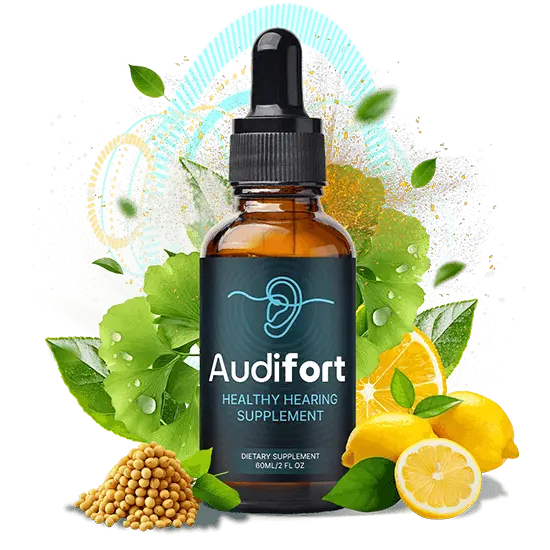
Quick overview
Audifort is a liquid dietary supplement for hearing support, built on a biologically reasonable premise with real research behind several named ingredients — and no published evidence about the finished product. A plausible formula, not a proven one.
- Category
- Dietary supplement, not a medicine
- Format
- Liquid drops, 60 ml / 2 fl oz (verified)
- Positioning
- Hearing and auditory wellness
- Formula
- 6 named; maker claims over 20 in total
- Verified
- Format, packages, pricing, bonuses, 90-day guarantee
- Not verified
- Full ingredient list, doses, certifications
What is Audifort?
Audifort is a liquid supplement in a 60 ml amber dropper bottle, sold direct to consumers online and regulated as food rather than medicine — which is why it cannot be sold as a treatment. For the full background, see our page on Audifort ingredients and formula.
Audifort ingredients review
Six ingredients are named publicly; the maker states the formula contains over 20. The remainder and every dose are unknown. Here is how the disclosed six hold up.
- Grape seed extract is the strongest entry: a meta-analysis found improved flow-mediated dilation and lower blood pressure3 — relevant, since the cochlea depends on a fragile microcirculation, but measured in peripheral arteries.
- Green tea extract improved vasodilation in meta-analysis4, and EGCG protected cochlear cells against chemotherapy damage in animals5 — the closest thing here to a hearing outcome, still preclinical.
- Gymnema sylvestre has real evidence, but for the wrong endpoint — glycaemic markers in diabetes6. Worth knowing as an interaction risk.
- GABA has a genuine role in auditory processing, but that role is inside the brain, and how much oral GABA crosses the blood–brain barrier is unresolved7.
- Capsicum annuum and maca root are the weakest links: neither has human research linking it to hearing.
What does the research say?
No study has tested Audifort. Everything above examined an isolated ingredient, and the evidence type varies enormously — human meta-analyses for grape seed and gymnema, animal models for EGCG. Those are not interchangeable.
The wider picture is sobering. Cochrane reviewed Ginkgo biloba, the most studied ingredient in this category, and found the evidence too uncertain to establish a tinnitus benefit1. Antioxidant trials produced mixed results2. The intervention with the strongest recent evidence was hearing treatment, in the ACHIEVE trial8 — not a supplement.
Scientific Reference Disclaimer: Research cited on this website provides general educational information about hearing physiology, auditory health, dietary ingredients and related topics. Unless explicitly stated, these studies did not test the finished Audifort product and should not be interpreted as proof of product effectiveness.
Does Audifort work?
Nobody can answer that from evidence, because the product has never been tested. A confident yes would be fabrication; a confident no would overstate what absence of evidence proves.
What can be said is narrower: the rationale is coherent, and two ingredients have measurable vascular effects in humans at studied doses — though whether those doses are present here is unknowable without a Supplement Facts panel.
Audifort benefits
Stated carefully, the formula is marketed around three areas and designed to support rather than deliver them: antioxidant protection, healthy circulation, and nervous-system signalling. Those mechanisms recur across hearing research9, which is why the positioning is credible even where product evidence is absent.
What we will not repeat: it does not cure or treat hearing loss, eliminate tinnitus, regenerate hair cells or auditory nerve fibres, or guarantee any result.
Audifort safety and side effects
We are not publishing a side-effect list, because no safety data exists for this blend. Safety depends on the ingredients, their doses, your medication and your health.
At ingredient level: gymnema may add to glucose-lowering medication; grape seed has antiplatelet potential; capsaicin irritates the gut; green tea extract has been linked to rare liver injury10.
Is Audifort legit?
It is a real, identifiable product with a real seller, checkout and stated refund policy — a different question from whether it works. Assessed on verifiable characteristics, not testimonials:
- Consistent labelling across the seller's materials: Audifort, 60 ml, dietary supplement.
- Pricing, packages and bonuses are published and internally consistent.
- A 90-day money-back guarantee stated in three separate seller materials.
- Payment runs through an established processor with a documented refund route.
Against that, transparency has real gaps: no public Supplement Facts panel, no full ingredient list, no verifiable certification, no clinical trial. Some marketing around this product is also indefensible — "FDA Approved" badges and stock physicians presented as endorsers.
Pros and cons
Pros
- Six ingredients disclosed publicly
- Two ingredients have human meta-analysis evidence
- Liquid dropper format, verified on the label
- Pricing, bonuses and shipping published up front
- 90-day refund window, verified in three seller materials
- Rationale aligns with mechanisms in real hearing research
Cons
- No published clinical trial of the finished product
- No public Supplement Facts panel, so doses are unknown
- Most of the claimed 20+ ingredients are never named
- Serving instructions are inconsistent across sources
- No verifiable manufacturing or quality certification
- Entry package is two bottles with paid shipping
- Supplements are not substitutes for hearing care
Who should talk to a healthcare professional?
Speak to a pharmacist or doctor first if you take prescription medication — especially anticoagulants, blood-pressure medication, sedatives or diabetes medication — or live with diabetes, cardiovascular, neurological, liver or thyroid conditions, are pregnant or breastfeeding, have surgery scheduled, or are considering it for someone under 18. Some symptoms need urgent assessment: sudden hearing loss, loss in one ear, ear pain or discharge, pulsatile tinnitus, vertigo11.
Audifort review conclusion
Audifort is a competently presented supplement with a defensible rationale and clearly published offer information — and an evidence base that stops well short of its category's marketing. Grape seed and green tea have genuine human data, but about blood vessels, not hearing.
If you try it on that understanding, the 90-day window is long enough to form a view and the three-bottle package matches it. If you wanted evidence that it improves hearing, that does not exist yet. Either way, the highest-value action is not on this page: protect your ears from noise, and get tested if anything has changed.
Audifort review FAQs
It is a real product from an identifiable seller, with published pricing, a documented checkout and a 90-day refund policy verified across three seller materials — a genuine offer rather than a scam, which is separate from whether it works. Gaps remain: no public Supplement Facts panel, no full ingredient list, no verifiable certification.
Nobody can answer that from evidence, because no published study has tested the finished product. Some ingredients have human research behind them, but for vascular and metabolic endpoints rather than hearing, at doses this formula does not disclose.
No, and no dietary supplement is — the FDA does not approve supplements before sale. Facilities can be FDA-registered and makers can follow Good Manufacturing Practices, but those are different claims, and we could not verify certification here.
No. No dietary supplement is approved to treat, cure or reverse hearing loss, and human cochlear hair cells do not regenerate once lost. Hearing loss needs professional assessment; sudden or one-sided loss needs it urgently.
No safety data exists for this blend, so we do not publish a side-effect list. At ingredient level, gymnema may add to glucose-lowering medication, grape seed has antiplatelet potential, capsaicin can irritate the gut, and green tea extract has been linked to rare liver injury. Check the label against your medication.
It depends what you expect. As general nutritional support with a coherent rationale and a 90-day refund window, it is reasonable to try. As a solution to hearing loss or tinnitus it is not supported by evidence, and the money is better spent on a hearing assessment.
References
Each verified against its PubMed record. Full titles and the complete 31-source list are on the main Audifort guide.
- Sereda M, et al. Cochrane Database Syst Rev. 2022. PMID 36383762
- Petridou AI, et al. Nutrients. 2019. PMID 31842394
- Foshati S, et al. Pharmacol Res. 2022. PMID 34798267
- Ras RT, et al. PLoS One. 2011. PMID 21394199
- Borse V, et al. Cell Death Dis. 2017. PMID 28703809
- Devangan S, et al. Phytother Res. 2021. PMID 34467577
- Lu WY. Nutrients. 2026. PMID 42514458
- Lin FR, et al. Lancet. 2023. PMID 37478886
- Maniaci A, et al. Antioxidants (Basel). 2024. PMID 39061910
- Geller AI, et al. N Engl J Med. 2015. PMID 26465986
- Chandrasekhar SS, et al. Otolaryngol Head Neck Surg. 2019. PMID 31369359