Product information · Dietary supplement
The Audifort Supplement Explained
Audifort is sold as a dietary supplement rather than a medicine, and that single fact governs what it may claim, how it is regulated and what you can reasonably expect from it. This page sets out the category, the formula and the safety points that follow from it.
- 60 ml bottle
- Liquid dropper
- 6 ingredients disclosed
What is the Audifort supplement?
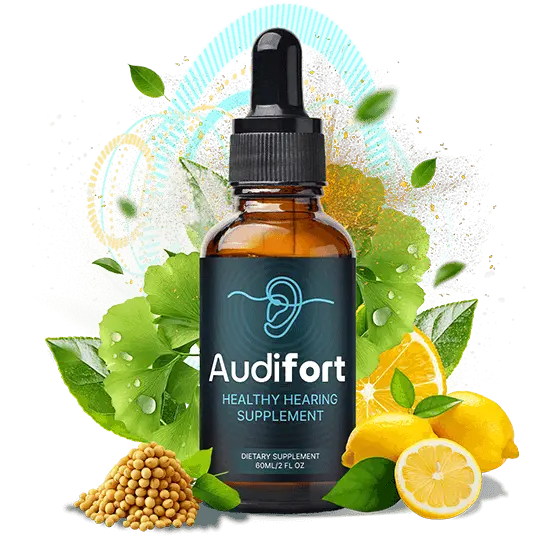
Audifort is a liquid dietary supplement sold in a 60 ml (2 fl oz) dropper bottle and labelled as a healthy hearing supplement. It is regulated as a food rather than as a drug, sold direct to consumers online, and marketed as general nutritional support for hearing and auditory wellness rather than as a treatment for any condition.
The supplement category, and why it matters
In the United States a dietary supplement occupies a specific legal space. It is regulated as a category of food, not as a medicine. A manufacturer does not have to demonstrate to a regulator that a product works before putting it on sale, and in exchange it may not market that product as treating, curing or preventing a disease. Structure and function language — "supports", "helps maintain" — is permitted; disease language is not.
That trade-off explains almost everything about how supplements like this one are written and sold. The careful phrasing on a sales page is not evasiveness for its own sake; it is the boundary of what the category legally allows. It also means the burden of evaluation falls on the buyer in a way it does not with a prescription. Nobody has checked this formula for you.
What the label discloses
The product label identifies Audifort as a dietary supplement, gives the volume as 60 ml / 2 fl oz, and describes it as a healthy hearing supplement. The seller states that the formula holds more than twenty ingredients but names six of them publicly:
- Capsicum Annuum — chili pepper fruit, the source of capsaicin, included on an energy and circulation rationale.
- Maca Root — a Peruvian root vegetable used across the supplement industry for energy and vitality.
- Gymnema Sylvestre — an Ayurvedic shrub whose documented research is metabolic rather than auditory.
- Grape Seed — a proanthocyanidin-rich extract with real human data on vascular measures.
- GABA — the principal inhibitory neurotransmitter of the central nervous system.
- Green Tea — standardised for catechins, chiefly EGCG.
What is not disclosed is as important as what is. The remaining ingredients are not itemised anywhere in the public materials, and no Supplement Facts panel showing individual amounts was available to us. Since dose determines whether an ingredient does anything at all, that gap limits how far anyone can evaluate this formula from the outside.
Why the formula is built this way
Read as a set, the six disclosed ingredients map onto three mechanisms that recur throughout hearing research: antioxidant balance, blood supply and neural signalling. The cochlea is metabolically demanding and depends on a fine, fragile microcirculation with no meaningful backup supply.2 Oxidative stress is one of the most consistent themes in the literature on cochlear damage.1 Building a supplement around those mechanisms is therefore a reasonable design choice.
A reasonable design choice is not a demonstrated effect. Grape seed extract has meta-analysed effects on flow-mediated dilation and blood pressure,3 and tea has measurable effects on endothelial function,4 but both were measured in peripheral arteries in people selected for cardiometabolic reasons, not in the inner ear and not for hearing outcomes.
Supplement safety in this category
"Natural" is not a synonym for inert. US surveillance data attribute thousands of emergency department visits each year to supplement-related adverse events, with older adults over-represented.5 Herb interactions with prescription medication are well documented; warfarin alone has a substantial published interaction literature.6
Two ingredients here carry specific, checkable signals. Gymnema sylvestre has meta-analysed effects on glycaemic markers,7 which makes it relevant to anyone taking glucose-lowering medication. Grape seed extract has antiplatelet potential worth raising before surgery or alongside anticoagulants. Concentrated green tea extract has been associated with rare liver injury at high intakes, and capsaicin commonly irritates the gut.
What to check before you take it
Whatever a sales page says, the bottle in your hand is the authority. Read the Supplement Facts panel and confirm the full ingredient list against anything else you take, including other supplements — duplicated botanicals across two products are a common and avoidable problem. Check the directions printed on the label rather than a figure quoted online; the instructions circulating for this product are inconsistent, so we do not publish a serving size. Note the expiry date, and store a liquid formula as directed, since liquids are generally less stable than dry ones once opened.
If you take prescription medication, five minutes with a pharmacist before the first dose is the single most useful thing you can do. It is free, it is quick, and it is far easier than unpicking an interaction afterwards.
What a supplement is not
Audifort is not a medicine, not a medical device and not a hearing aid. It is not a substitute for a hearing test, and starting it is not a reason to postpone one. Some symptoms need assessment rather than nutrition, and some need it urgently — sudden hearing loss over hours or days is treated as a medical emergency in the current clinical guideline, where outcomes are strongly time-dependent.8 The same applies to loss in one ear only, ear pain or discharge, tinnitus that pulses with your heartbeat, and vertigo.
Related Audifort pages
- What Audifort is — the main product page and its hearing-support positioning
- the liquid drops format — why it is a dropper rather than a capsule
- whether Audifort works — what the evidence does and does not establish
- a legitimacy check — what can actually be verified about the seller and product
Frequently asked questions
It is a dietary supplement, regulated as a food rather than as a drug. It is not a prescription medicine and is not intended to diagnose, treat, cure or prevent any disease.
Six are named publicly: Capsicum Annuum, Maca Root, Gymnema Sylvestre, Grape Seed, GABA and Green Tea. The seller states the formula holds over twenty in total, but the remainder are not itemised and no individual amounts are published.
That is not published. No Supplement Facts panel giving individual amounts was available to us, which means the formula cannot be compared against the doses used in research. Read the panel on the bottle you receive.
No safety data exists for this specific blend. At ingredient level, gymnema may add to glucose-lowering medication, grape seed has antiplatelet potential, concentrated green tea extract has been linked to rare liver injury, and capsaicin can irritate the gut. Check with a pharmacist if you take anything prescribed.
No, and it does not have it. The FDA does not approve dietary supplements before sale or evaluate them for effectiveness, so any "FDA approved" wording on a supplement page is inaccurate.
References
Each verified against its PubMed record or issuing body. The complete source list is on the main Audifort guide.
- Maniaci A, et al. Hearing loss and oxidative stress: a comprehensive review. Antioxidants. 2024. PMID 39061910
- Shi X. Physiopathology of the cochlear microcirculation. Hear Res. 2011. PMID 21875658
- Foshati S, et al. Grape seed extract, flow-mediated dilation and blood pressure. Pharmacol Res. 2022. PMID 34798267
- Ras RT, et al. Tea consumption enhances endothelial-dependent vasodilation. PLoS One. 2011. PMID 21394199
- Geller AI, et al. Emergency department visits for adverse events related to dietary supplements. N Engl J Med. 2015. PMID 26465986
- Tan CSS, et al. Warfarin and food, herbal or dietary supplement interactions. Br J Clin Pharmacol. 2021. PMID 32478963
- Devangan S, et al. Gymnema sylvestre and glycaemic control in type 2 diabetes. Phytother Res. 2021. PMID 34467577
- Chandrasekhar SS, et al. Clinical practice guideline: sudden hearing loss (update). Otolaryngol Head Neck Surg. 2019. PMID 31369359